Most people meet their Ascendant first: the rising sign, the one that describes how you come across. Its opposite gets less attention. The Descendant, or DSC, is the point of the zodiac that was setting on the western horizon when you were born, and astrologers read it for the other half of life: partners, close collaborators, and the people who seem to arrive with lessons attached.
This guide explains how to read the Descendant without turning it into a description of a future spouse. It uses one worked example throughout, calculated with the same engine as the free Descendant calculator: a birth in Hangzhou on 22 August 1994 at 18:30, the moment the Sun was setting.
The Descendant is where the sky sets
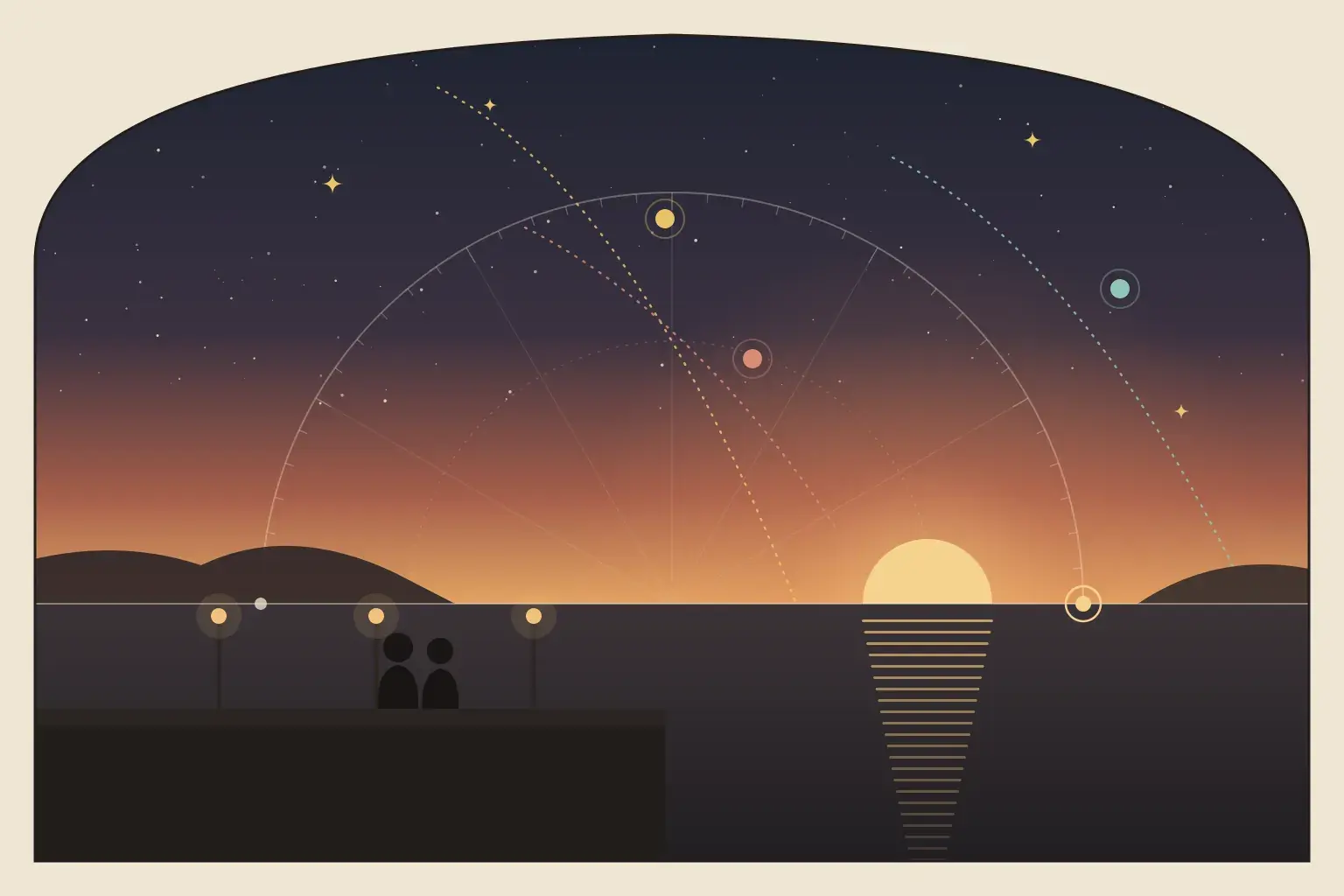
The sample chart was born as the Sun touched the western horizon of Hangzhou. Watch its real path and the DSC degree change together.
The western horizon of your chart
A birth chart is drawn around the horizon. The Ascendant is the degree rising in the east; the Descendant is the degree setting in the west, always exactly 180° away. In the sample chart the Ascendant is Aquarius 29°01′, so the Descendant is Leo 29°01′.
The DSC opens the 7th house. Traditional astrology calls it the house of the other: marriage and partnership, but also business partners, close rivals and anyone you deal with one to one. Where the Ascendant describes how you meet the world, the Descendant is usually read as what you look for, or keep meeting, in other people.
Read the sign as a pattern, not a person
A Leo Descendant does not mean a Leo partner. It is read as a theme: being drawn to warmth, confidence and visibility in others, perhaps while learning to show those qualities yourself. The sign is the start of a reading, not the conclusion.
Four pieces of chart evidence add detail, and the calculator shows each of them:
- The sign and degree, including how close it sits to the next sign.
- The ruler, the planet that governs the DSC sign, and where it is. In the sample the ruler of Leo is the Sun, and it sits right on the Descendant in the 7th house.
- Planets in the 7th house. Here the Sun, Mercury and Chiron. An empty 7th house is common and says nothing about whether you will have relationships.
- Aspects to the DSC, with their orbs. The sample has a near-exact Sun conjunction, a wider Pluto square and a Mars sextile.
If you are curious how Venus fits in, Venus on the MC versus the DC compares the two classic "love" placements on a map.
Three minutes can change the sign
The Descendant moves fast. Because the Earth turns, a new degree of the zodiac reaches the western horizon about every four minutes, and the DSC changes sign roughly every two hours.
Three minutes can change the sign
The sample DSC over four hours around the birth time.
At 18:30 the DSC is Leo 29°01′. At 18:33 it is Virgo. A time rounded to the half-hour would give the wrong sign.
In the sample chart, 18:30 gives Leo 29°01′. By 18:33 the Descendant is in Virgo. A birth time remembered as "about half past six" cannot settle which of the two it is. If your time is approximate, read how to use astrocartography without a birth time and treat the DSC as provisional.
Not every sign takes two hours, either. Signs rise and set at different speeds, and the difference grows with latitude.
Not every sign gets two hours
Hours each sign spends on the Descendant in one sidereal day, by latitude.
At Hangzhou's latitude, Virgo and Libra pass the Descendant in about 1.4 hours; Taurus and Aquarius take almost 2.4. Near Stockholm, a Virgo Descendant lasts about 32 minutes a day. That is one reason the sign boundary is easy to miss, and one reason some Descendant signs are simply rarer in the north.
The Descendant changes when you move
Planets are in the same zodiac positions wherever you stand, but the horizon is not. Cast the same birth moment for another city and the Ascendant and Descendant change. That is the idea behind a relocation chart.
Same birth moment, different Descendant
The DSC of the sample chart, cast for eight cities at the same instant.
- 1HangzhouLeo 29°01′
- 2ShanghaiVirgo 0°25′
- 3ChengduLeo 8°26′
- 4TokyoVirgo 26°22′
- 5SingaporeLeo 19°05′
- 6LondonAries 26°38′
- 7New YorkPisces 1°32′
- 8SydneyLibra 7°46′
For the sample chart, Shanghai, about 160 km away, already has a Virgo Descendant. Chengdu, further west, has Leo 8°. London's DSC is in Aries, New York's in Pisces, Sydney's in Libra. None of this changes who you are. Astrologers who use relocation charts read it as a change in emphasis: which part of the chart sits on the partnership axis in the place where you live.
Descendant lines: where your planets were setting
Astrocartography takes the same idea and draws it across the globe. Every planet has a Descendant line, the places where that planet was setting at your birth. The calculator lists major cities within 500 km of each one.
Where the sample chart’s planets were setting
Descendant lines of five planets for the same birth moment, with the nearest major city to each.
 VenusJupiterMoonSunSaturn
- Hangzhou · Sun DSC · 33 km
- Buenos Aires · Moon DSC · 428 km
- Brisbane · Venus DSC · 608 km
- São Paulo · Saturn DSC · 503 km
The sample's Sun Descendant line runs straight through Hangzhou, as it must, because the Sun was setting there. The Moon's line crosses South America about 430 km from Buenos Aires, Venus runs through the Tasman Sea about 600 km off Brisbane, and Jupiter's line crosses the open Pacific without a major city nearby.
How do astrologers read these lines? Venus and Jupiter Descendant lines are the ones most often described as easing partnership: more warmth, generosity or openness in close relationships. The Moon on the DSC is read as emotional closeness; the Sun as relationships becoming central to how you see yourself. Saturn and Pluto are read as places where relationships ask for more commitment and honesty. That is not a warning sign. Many people do their most serious relationship work in exactly those places.
Distance matters. Influence is usually described as strongest within roughly 100–150 km and fading over a few hundred; how close you need to be to a line explains where those numbers come from and why astrologers disagree. For a closer look at the classic relationship line, see Venus on the Descendant.
Read it in five steps
Read a Descendant in five steps
1Sign and degree
Note the DSC sign and how close it is to a sign boundary.
2Its ruler
Find the planet that rules the DSC sign, and the sign and house it occupies.
37th house and aspects
List planets in the 7th house and planets aspecting the DSC, with their orbs.
4The map
Check which cities lie near your DSC lines, and how far away they are.
5Real life
Compare the reading with your actual relationships before you draw any conclusion.
The order matters less than the habit: keep each piece separate, note how strong it is, and only then put them together. A reading built this way is easy to check against your own experience, and easy to revise when it does not fit.
Keep the limits visible
A chart cannot tell you who you will meet, whether a relationship is right for you, or where you will find a partner. Moving to a city on a Venus line does not create a relationship, and living near a Saturn line does not prevent one. Astrology is a symbolic practice, not a validated way to predict relationships.
Used carefully, the Descendant is still a good question to ask. What do you look for in other people? Which qualities do you hand to a partner instead of developing them yourself? And if you are weighing a move, does the place you are considering support the kind of relationships you want? Answer those with real conversations and real visits. The chart's job is to help you ask them.