Live ephemeris
Planetary Positions Today
Planetary positions today put the Sun at 17° Libra and the Moon at 16° Libra. Below is the whole geocentric sky for this moment: each body's sign, exact degree, speed and retrograde state, the aspects in orb, the next stations, and the Moon's void-of-course window.
Sun
17°17′ Libra
Moon
16°20′ Libra
Moon phase
New Moon
0% illuminated
- Sun 17° Libra
- Moon 16° Libra
- Mercury 12° Scorpio
- Venus 7° ScorpioR
- Mars 7° Leo
- Jupiter 21° Leo
- Saturn 10° AriesR
- Uranus 5° GeminiR
- Neptune 2° AriesR
- Pluto 3° AquariusR
- Chiron 29° AriesR
- North Node 28° AquariusR
Retrograde right now
Venus, Saturn, Uranus, Neptune, Pluto and Chiron retrograde. Everything else moves direct.
Moon void of course
Not void yet. The Moon makes a sextile to Jupiter at October 10, 2026, 23:07 UTC, then runs void until it enters Scorpio at October 11, 2026, 15:21 UTC.
Planetary positions today, body by body
| Body | Position | Daily motion | Next sign change |
|---|---|---|---|
| Sun | 17°17′ Libra | +0.99° | Scorpio · October 23, 2026 |
| Moon | 16°20′ Libra | +13.03° | Scorpio · October 11, 2026, 15:21 UTC |
| Mercury | 12°14′ Scorpio | +1.06° | Sagittarius · December 6, 2026 |
| Venus | 7°26′ ScorpioR | -0.29° | Libra · October 25, 2026 |
| Mars | 7°11′ Leo | +0.56° | Virgo · November 25, 2026 |
| Jupiter | 21°14′ Leo | +0.16° | — |
| Saturn | 10°49′ AriesR | -0.08° | — |
| Uranus | 5°20′ GeminiR | -0.02° | — |
| Neptune | 2°36′ AriesR | -0.03° | — |
| Pluto | 3°05′ AquariusR | +0.00° | — |
| Chiron | 29°04′ AriesR | -0.05° | — |
| North Node | 28°54′ AquariusR | -0.12° | — |
Tropical zodiac, measured from the centre of the Earth. Slow bodies show no sign change because they can hold one sign for years.
Aspects between these positions right now
| Aspect | Orb | Phase |
|---|---|---|
| Venus square Mars | 0.26° | Applying |
| Neptune sextile Pluto | 0.47° | Separating |
| Sun conjunction Moon | 0.96° | Separating |
| Mars sextile Uranus | 1.84° | Separating |
| Uranus trine Pluto | 2.26° | Applying |
| Uranus sextile Neptune | 2.73° | Separating |
| Mars trine Saturn | 3.65° | Applying |
| Sun sextile Jupiter | 3.96° | Applying |
| Pluto square Chiron | 4.01° | Separating |
| Mars opposition Pluto | 4.10° | Separating |
| Venus square Pluto | 4.37° | Applying |
| Mars trine Neptune | 4.57° | Separating |
| Mercury conjunction Venus | 4.79° | Separating |
| Moon sextile Jupiter | 4.91° | Applying |
| Mercury square Mars | 5.05° | Separating |
| Moon opposition Saturn | 5.50° | Separating |
| Sun opposition Saturn | 6.46° | Separating |
Orbs match the ones our natal chart uses, so an aspect named here is named there too. Applying means the orb is still closing; separating means it has already been exact.
When each planet next stations
- Pluto turns direct Oct 15, 2026
- Mercury turns retrograde Oct 23, 2026
- Venus turns direct Nov 13, 2026
- Saturn turns direct Dec 9, 2026
- Neptune turns direct Dec 11, 2026
- Jupiter turns retrograde Dec 12, 2026
- Chiron turns direct Jan 5, 2027
- Mars turns retrograde Jan 9, 2027
- Uranus turns direct Feb 7, 2027
A station is the moment a body stops and reverses. Times are UTC, though a planet crawls so slowly near a station that it is effectively motionless for days either side.
The main tool
Your own lines never move
The sky above is shared and it turns. The one cast at your birth is fixed for life, and it is the one that says where you belong rather than where a planet happens to be tonight. Enter a birth date, time and place and the map draws every line.
Where today’s planetary positions land on Earth
A sign and a degree answer a question about time, and that answer is the same for a reader in Lagos as for one in Lima. But a planet standing at 29° Leo is also standing directly over one exact point on the ground, and the meridian it culminates on sweeps west as the Earth turns. The map below is that half of the answer: not what sign each body occupies, but which part of the world it is over at this moment.
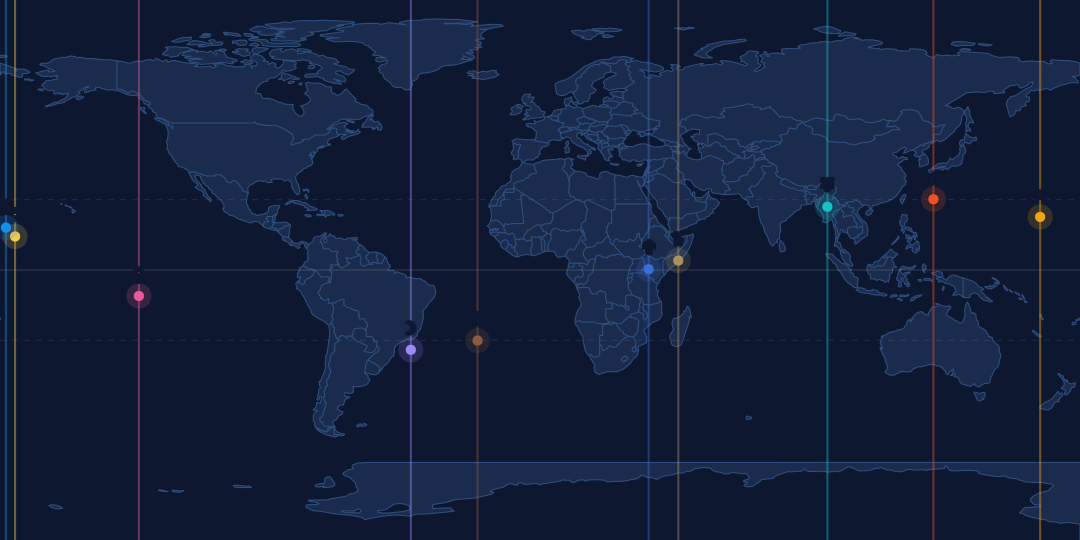
Directly overhead right now
- ☉ Sun stands over open country — the nearest large town is João Pessoa, Brazil, 301 km away
- ☽ Moon stands over Maceió, Brazil
- ☿ Mercury stands over the South Atlantic
- ♀ Venus stands over the South Atlantic
- ♂ Mars stands over San Martin Texmelucan de Labastida, Mexico
- ♃ Jupiter stands over La Ceiba, Honduras
- ♄ Saturn stands over open country — the nearest large town is Jayapura, Indonesia, 539 km away
- ♅ Uranus stands over open country — the nearest large town is Honolulu, United States, 705 km away
- ♆ Neptune stands over Manokwari, Indonesia
- ♇ Pluto stands over the Indian Ocean
Cities under a transiting line right now
82 of the cities we track sit within 350 km of a line cast by the sky above — the same band we treat as a hit on a natal map. This list changes as the Earth turns, so a city near the top now will be clear of it within the hour.
- Saint Petersburg, Russia — Mars setting, 14 km
- Quito, Ecuador — South Node overhead, 26 km
- Mogadishu, Somalia — Neptune rising, 36 km
- Kinshasa, Democratic Republic of the Congo — Uranus underfoot, 42 km
- Tehran, Iran — Saturn rising, 47 km
- Los Angeles, United States — Moon rising, 59 km
- Bangkok, Thailand — Uranus rising, 61 km
- Melbourne, Australia — Moon underfoot, 62 km
- Rome, Italy — Pluto rising, 67 km
- Hyderabad, India — Pluto overhead, 69 km
- Kano, Nigeria — Jupiter setting, 70 km
- Toronto, Canada — South Node overhead, 77 km
These lines belong to this moment, and to everybody at once. Your own are different: they are cast by the sky at your birth, they never move, and they say something about you rather than about today.
Map your own lines01
How to read planetary positions today
Each row places one body in the tropical zodiac. The position column reads as degrees and minutes inside a sign, so 14°14′ Aries means the body is a little over fourteen degrees into the thirty that make up Aries.
Daily motion is how far it travels along the ecliptic in twenty-four hours, and it is the number that tells you how long a contact lasts. The Moon covers twelve to fifteen degrees a day, so its transits are over within hours; Pluto moves a fiftieth of a degree and can hold the same point for a year. A negative value means retrograde, marked with an R.
02
Geocentric, tropical, and stated in UTC
Three conventions decide the numbers, and sites make different choices, which is why two ephemerides can disagree by a whole sign. These readings are geocentric — measured from the centre of the Earth, the standard for Western astrology — and use the tropical zodiac, anchored to the equinox rather than to the constellations.
The timestamp is UTC. A planet's zodiacal position depends only on when you look, never on where you stand, so one UTC reading is correct everywhere on Earth. Your location starts to matter only when houses and angles enter the picture, which is what a birth chart adds.
The node shown is the true node, which wobbles and can briefly turn direct. Ephemerides publishing the mean node differ by up to about a degree and a half.
03
What retrograde actually means
Retrograde motion is a trick of perspective, not a change in behaviour. Every planet keeps orbiting the Sun the same way throughout. When Earth overtakes a slower outer planet, that planet appears to slide backwards against the stars for a few weeks, the way a car you pass seems to drift backwards against the trees.
The retrograde column is therefore derived rather than looked up: each body's longitude a day before is compared with a day after, and a negative difference is the definition. Worth knowing which planet is involved, too — Mercury gets the attention, but Saturn, Neptune, Pluto and Chiron each spend four to five months a year retrograde, so "something is retrograde" is nearly always true and nearly never the interesting part.
04
Turning planetary positions into your own transits
This table is the sky as it stands for everyone. It turns personal only when laid over your birth chart: a transit is a body making an angle to a point in your own chart, so a position on its own says nothing about your week. Mars at 6° Cancer is neutral until you know whether you have anything near 6° of Cancer, Capricorn, Aries or Libra.
Generate your birth chart, note the degrees of your Sun, Moon and Ascendant, then scan for bodies within a few degrees of them. The daily-motion column tells you how long each contact lasts — a fast body within one degree is a two-day event, while a slow retrograde body crosses the same point three times across most of a year.
- Same degree, same sign — the strongest and most literal contact.
- Same degree, opposite sign — tension that tends to arrive through other people.
- Same degree, four signs away — the easy one, often unnoticed.
- Same degree, three signs away — the friction that forces a decision.
05
Where today's positions meet the place you live
An astrocartography map starts from these same positions, then adds the Earth's rotation to ask a different question: not what sign a planet occupies, but which places on Earth have it rising or overhead. Your own lines are fixed for life because they come from your birth moment, while the positions above keep moving — and how they fall against your lines is what makes one year better than another for acting on a particular city.
Planetary positions today — common questions
What planets are retrograde right now?
Venus (7° Scorpio), Saturn (10° Aries), Uranus (5° Gemini), Neptune (2° Aries), Pluto (3° Aquarius) and Chiron (29° Aries) — read straight off the table above, which recalculates on every page load rather than serving a cached list.
Is the Moon void of course right now?
Not yet. The Moon still has a sextile to Jupiter to make before it goes void ahead of entering Scorpio. The card above the table gives the exact window.
When does the next planet station retrograde or direct?
The next one is Pluto turning direct on 15 Oct 2026. Every upcoming station is listed under the aspects, ordered by date.
Are these positions geocentric or heliocentric?
Geocentric, measured from the centre of the Earth, which is the standard for Western astrology. Heliocentric positions differ substantially for the inner planets.
Why do these differ from my Vedic astrology app?
This table uses the tropical zodiac, anchored to the equinoxes. Most Vedic astrology uses a sidereal zodiac anchored to the fixed stars, currently about twenty-four degrees behind — nearly a full sign, so the same planet often shows a different sign in each system.
Do I need to adjust these for my time zone?
No. A planet's zodiacal position depends only on the moment, so the UTC reading is valid everywhere. Time zone matters for houses and angles, which need a place as well as a time.
Can I look up planetary positions for another date?
Yes. Set the date and time in the picker and everything recalculates for that instant — positions, aspects, stations and the void window. Times are UTC and the resulting URL is shareable.
What do applying and separating mean?
Applying means the two bodies are still closing on the exact angle; separating means the aspect has already been exact and is widening. Most readings treat the applying half as the active one.
How accurate is this table?
Positions come from the same ephemeris behind our birth charts and astrocartography lines, accurate to well under an arc-minute. Sign changes, stations and the void window are solved to the minute rather than looked up, so an event reports the same time whenever you ask.
What is the difference between a position and a transit?
A position is where a body sits right now and is the same for everybody. A transit is that body making an angle to a specific point in your own birth chart.
Which lunar node is shown?
The true node, which follows the Moon's osculating orbit and can briefly station direct. Some ephemerides publish the smoothed mean node, always retrograde; the two differ by up to about a degree and a half.
Why is there no sign change for Jupiter, Saturn or Pluto?
Those bodies hold one sign for years — Pluto for twelve to thirty — so a countdown would not be useful. The column is filled for the Sun, Moon, Mercury, Venus and Mars, where an ingress is days or weeks away.
See where these planets fall on the map
The same positions, projected onto the world: the places where each planet sat on the horizon or overhead at your birth. Free, no sign-up.
Generate your astrocartography mapKeep reading
Birth chart calculator
Get your natal placements — positions only become transits once you have something to compare them to.
How to read an astrocartography map
What the lines are, how close counts, and how the four angles differ.
Planetary line meanings
What each planet does to a place, from the Sun through Chiron and the nodes.
Electional date picker
Turn moving positions into ranked dates for a specific decision.