BaZi, the four pillars of destiny, reads a birth as eight characters, each carrying one of five elements. Its best-known practical idea is the favorable element, 喜用神: the element a chart is read to need more of. Because each element also has a direction, people often ask the natural next question, which is where they should live.
This guide shows exactly how that answer is built on this site, with every figure calculated from the same engine that runs the free BaZi favorable elements calculator and the full map. It uses the same worked chart as the Descendant guide and the line crossings guide: a birth in Hangzhou on 22 August 1994 at 18:30.
Five elements, eight sectors
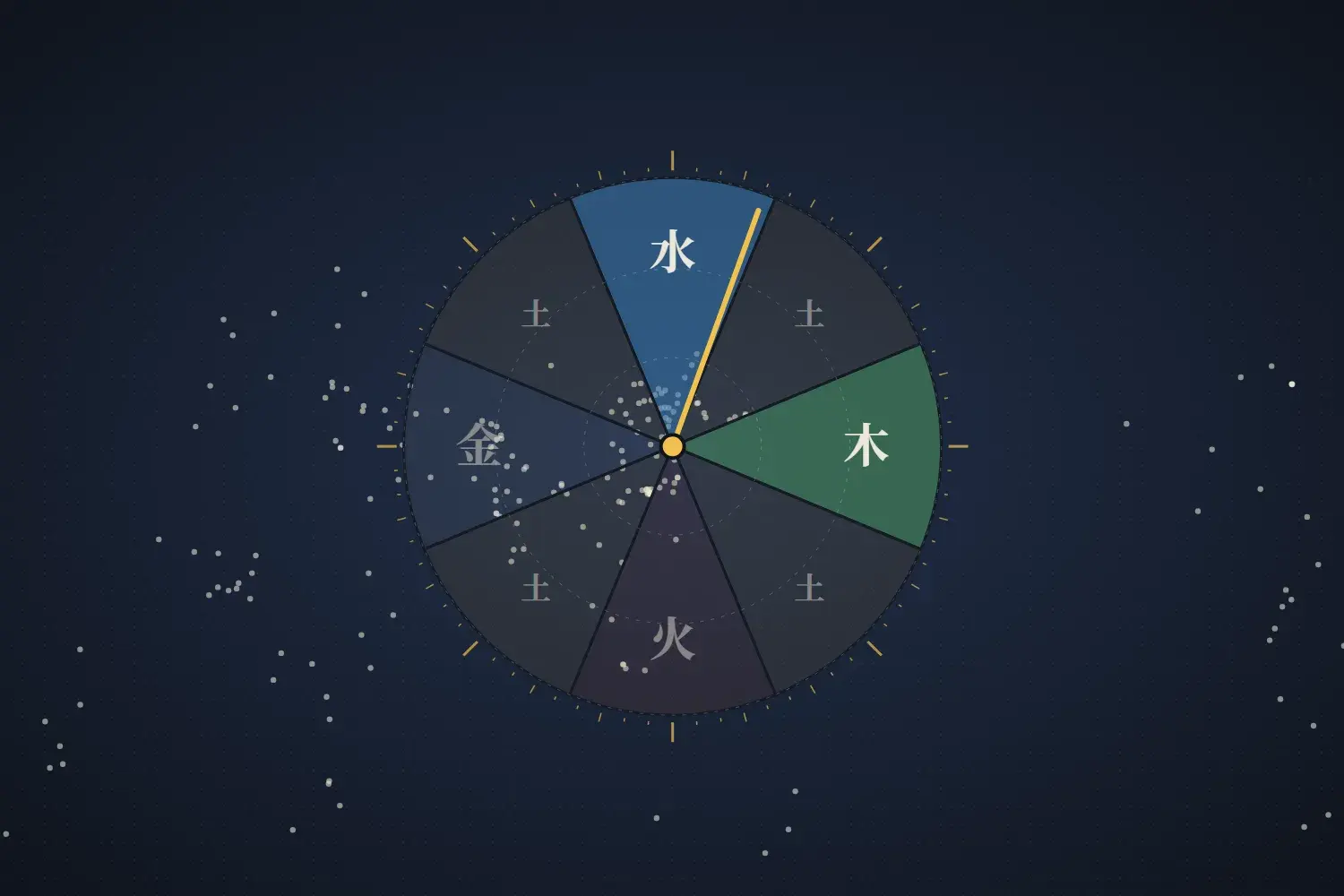
Each element has a traditional direction: water the north, wood the east, fire the south and metal the west. Earth belongs to the centre, which is easy on a courtyard plan and awkward on a world map, because there is no centre to move towards. This site reads earth on the four diagonals, the sectors that in BaZi belong to the earth branches 辰, 未, 戌 and 丑.
Eight sectors, five elements
Water, wood, fire and metal hold the four cardinal sectors, 45° each. Earth, traditionally the centre, is read on the four diagonals, as on this site’s map.
Directions are measured along the shortest route over the globe from the birthplace, the same way the map measures them. Over long distances that route curves, so a city can fall in a different sector here than it seems to on a flat map. From Beijing, for example, the shortest route to New York sets off just 8° east of due north, so New York counts as north (water), not east.
Strong or weak decides everything
The day master, the stem of the day pillar, stands for you. Whether it is strong or weak decides which elements are favorable. The worked chart's pillars are 甲戌 年, 壬申 月, 庚辰 日 and 乙酉 时: a 庚 (Geng) metal day master born in a 申 month, which is also metal. On this site's rule that is a strong day master, and the favorable elements are wood and water, the elements that metal controls and feeds.
Practitioners weigh many things to judge strength. This site uses one simplified rule everywhere, on the map, in reports and in the tool: the day master is strong when the month branch shares or generates its element. That makes the whole rule small enough to print.
The whole rule on one page
Strength here depends on two things only: the day master’s element and the month branch. Every one of the 21,915 days from 1950 to 2009 falls in exactly one cell.
| Month branch | 寅 | 卯 | 辰 | 巳 | 午 | 未 | 申 | 酉 | 戌 | 亥 | 子 | 丑 |
|---|---|---|---|---|---|---|---|---|---|---|---|---|
| Wood | StrongEarth·Fire | StrongEarth·Fire | WeakWater·Wood | WeakWater·Wood | WeakWater·Wood | WeakWater·Wood | WeakWater·Wood | WeakWater·Wood | WeakWater·Wood | StrongEarth·Fire | StrongEarth·Fire | WeakWater·Wood |
| Fire | StrongMetal·Earth | StrongMetal·Earth | WeakWood·Fire | StrongMetal·Earth | StrongMetal·Earth | WeakWood·Fire | WeakWood·Fire | WeakWood·Fire | WeakWood·Fire | WeakWood·Fire | WeakWood·Fire | WeakWood·Fire |
| Earth | WeakFire·Earth | WeakFire·Earth | StrongWater·Metal | StrongWater·Metal | StrongWater·Metal | StrongWater·Metal | WeakFire·Earth | WeakFire·Earth | StrongWater·Metal | WeakFire·Earth | WeakFire·Earth | StrongWater·Metal |
| Metal | WeakEarth·Metal | WeakEarth·Metal | StrongWood·Water | WeakEarth·Metal | WeakEarth·Metal | StrongWood·Water | StrongWood·Water | StrongWood·Water | StrongWood·Water | WeakEarth·Metal | WeakEarth·Metal | StrongWood·Water |
| Water | WeakMetal·Water | WeakMetal·Water | WeakMetal·Water | WeakMetal·Water | WeakMetal·Water | WeakMetal·Water | StrongFire·Wood | StrongFire·Wood | WeakMetal·Water | StrongFire·Wood | StrongFire·Wood | WeakMetal·Water |
Two things follow. First, strength does not depend on the hour, so for most people a birth time is not needed to know their favorable elements here. The exception is a birth between 23:00 and midnight, which belongs to the next day's pillar and can change the day master: if that is you, enter the time. Second, it is a rule, not a measurement: when the table says a wood day master born in a 子 month is strong, that is the rule applied, not something discovered about people born in December.
A headcount can point the other way
Many readers count characters instead. If your chart shows four fire characters, it can feel strange to be told your fire day master is weak. That clash is common, and it is worth knowing how common before trusting either answer.
When a headcount and the month disagree
A quick headcount asks whether the day master’s own element and the element that feeds it fill at least four of the eight characters. Across every day and two-hour slot from 1950 to 2009, it disagrees with the month rule in 35.7% of charts.
- Agree · 168,994
- Headcount strong, month weak · 70,229
- Month strong, headcount weak · 23,757
Across every day and two-hour slot from 1950 to 2009, a quick headcount and the month rule disagree in about a third of the combinations, mostly because the headcount sees support the month does not give. Neither is the "true" answer: they are two simplifications of a judgment practitioners make with more inputs. The tool says which one it uses and shows the count separately, so you can see when they disagree for your chart.
The same chart, two birthplaces
This is the part most guides leave out. Favorable elements belong to the chart, and each element keeps its direction wherever you stand. What changes with the birthplace is which places lie in those directions. Here are the worked chart's favorable elements, wood and water, seen from Hangzhou and, for comparison, from London.
One chart, two birthplaces
The worked chart’s favorable elements are wood and water, and each keeps its direction wherever you stand. From Hangzhou the favorable cities in the list all lie north; from London they all lie east, Berlin, Istanbul and Dubai among them. What changes is which places lie in those directions.
From Hangzhou
From London (same favorable elements)
- Favorable direction and a matching line within 600 km
- Favorable direction
- Other direction
From Hangzhou every favorable city in the list lies north, from Changzhou up to Harbin, and none of the listed cities lies east: Tokyo and Osaka sit at 66–67°, just outside the wood sector, and what lies inside it is mostly sea and smaller cities in Kyushu and Shikoku that the list does not include. From London the favorable cities in the list all lie east instead: Berlin, Istanbul, Baku and Dubai. North is still water from London, but no listed major city falls there within range. Nothing in the chart changed; only the places that lie in each direction did.
Where BaZi and the lines agree
A direction alone is a wide net. A more useful shortlist comes from cities where two systems point the same way. In the cross-reading this site uses, planets carry elements too: Jupiter and Uranus wood, the Sun and Mars fire, Saturn and Pluto earth, Venus metal, and the Moon, Mercury and Neptune water.
For the worked chart, eight cities north of Hangzhou also have a water-planet line within 600 km. Harbin sits 46 km from the Moon's Ascendant line and Changchun 131 km from it; Shenyang, Dalian, Yantai and Qingdao are further from the same line. The tool uses the same direction sectors and the same 600 km radius as the map's ranking. The map also weighs each line against your goal, so a line the tool counts as agreeing does not always add to a city's score there. See how we calculate and score cities for the full method.
Using the result
- 1Check the rule: strength comes from the month, so read the favorable elements as this site’s rule, not a final verdict.
- 2Look at the sectors from where you were born, not from where you live now.
- 3Shortlist cities that sit in a favorable sector and have a matching line nearby.
- 4Then research them: work, cost, language, people and daily life decide.
How to test a direction cheaply
A direction is a reason to look, not a reason to move. Before anything expensive, try the low-cost version: spend a week or two in a shortlisted city, work from there if you can, and notice sleep, energy, money and people. Compare it with a city outside your favorable sectors that you already like. If the difference is real for you, it will show in the diary, not in the chart.
The risks are ordinary ones: a move chosen for symbolism can cost a job, a support network or a lot of money. Keep the decision on practical evidence, and use where to live to compare cities on your goal with lines and BaZi together.
Try it with your own chart
Enter your birth date and birthplace in the BaZi favorable elements calculator. It shows your four pillars, the strength rule and the element count side by side, a compass centred on your birthplace, and the cities where a favorable direction and a matching line agree. A birth time is optional; without it the line check is skipped.